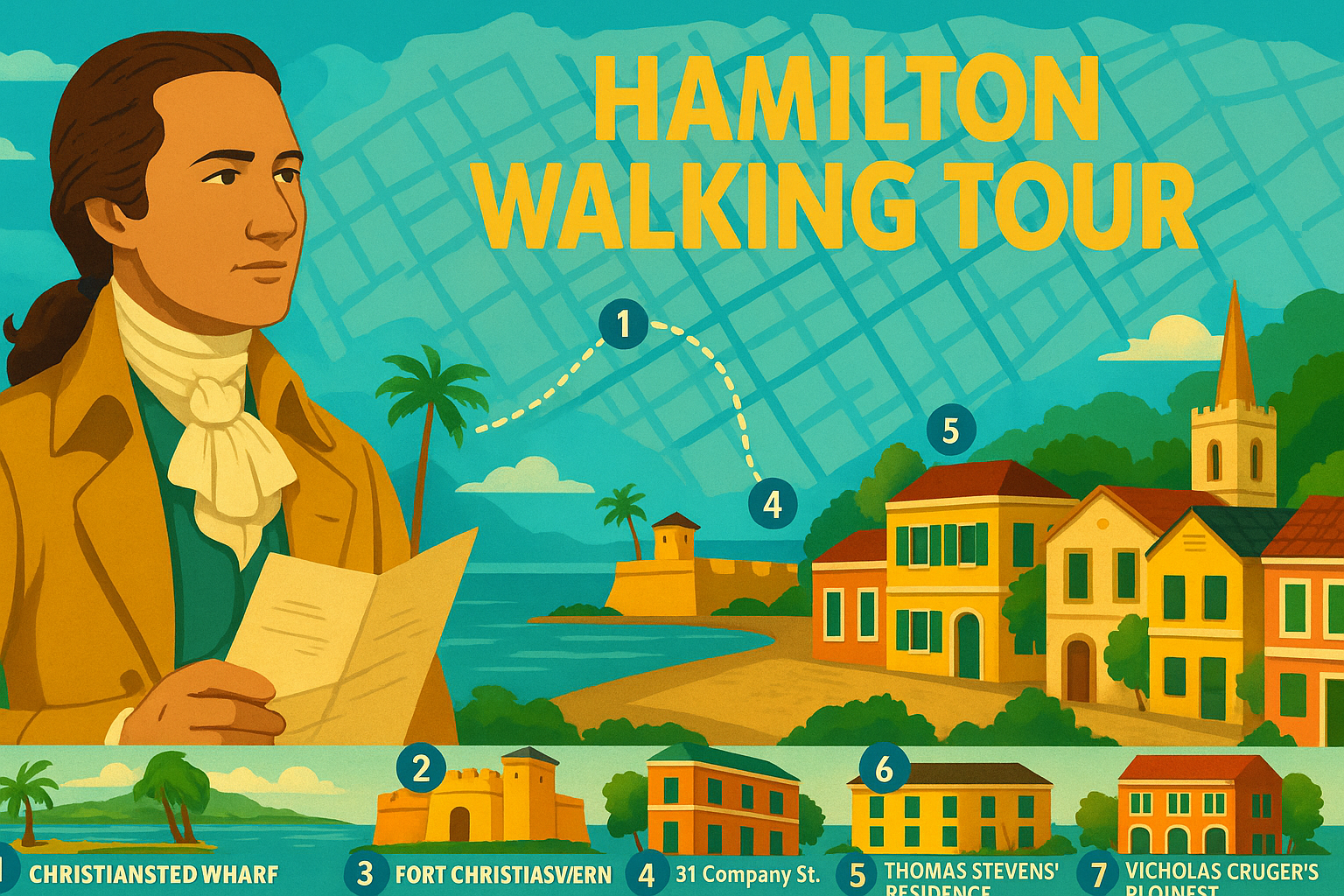


Few realize that Alexander Hamilton—America’s first Treasury Secretary and the man on the $10 bill—spent his childhood in Danish Christiansted. Between ages 10 and 18, the island’s bustling port, colonial edifices, and harrowing family dramas shaped the man he would become (you can read more here). Lace up your walking shoes and explore the seven sites that trace his West Indian roots.
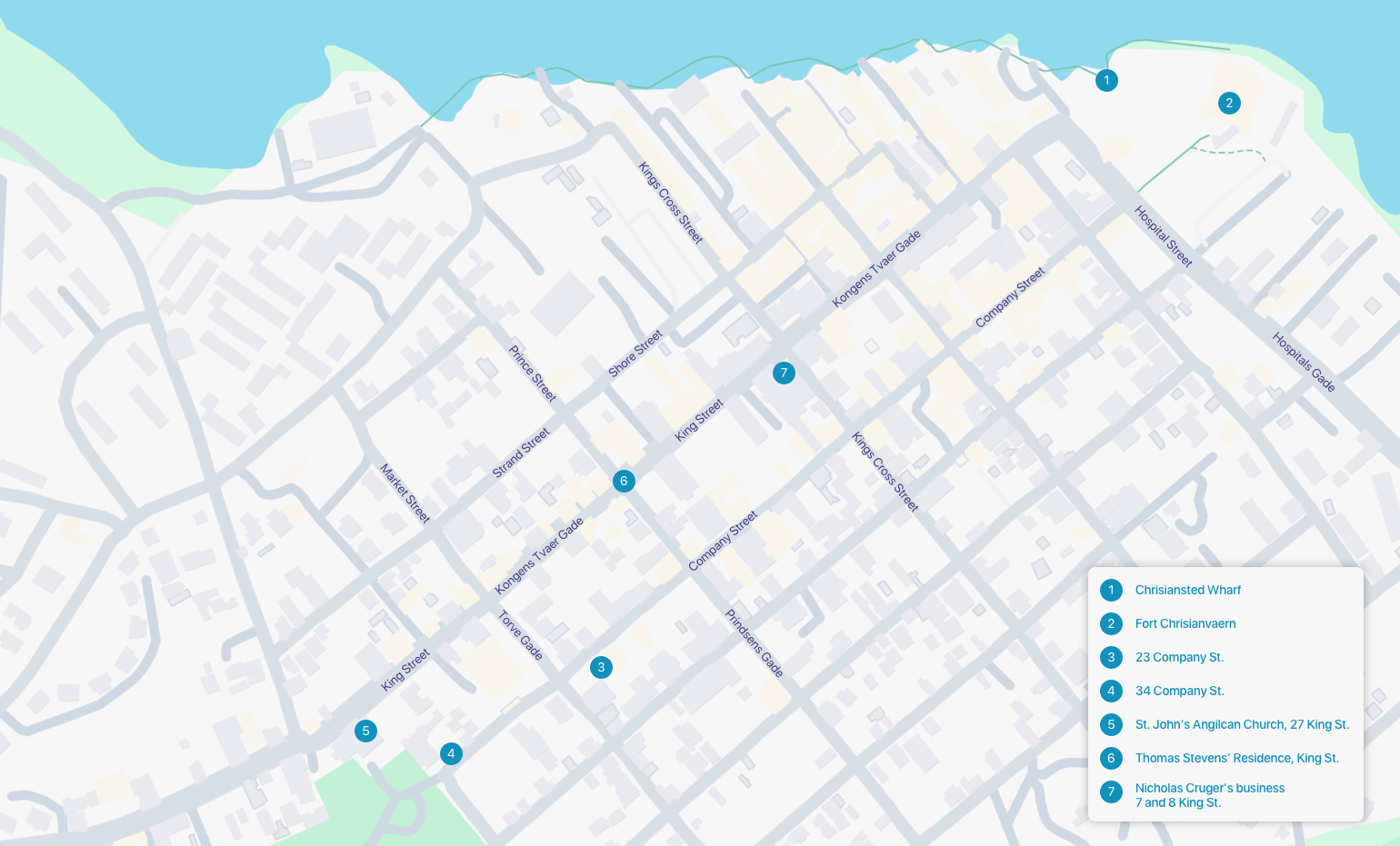
Stop 1: Christiansted Wharf
Intersection of King’s Wharf & Strand Street
This once-bustling quay welcomed sugar barges and merchant ships from Europe, Africa and the Americas. In May 1765, Hamilton’s family disembarked here, and in 1773 Alexander bade farewell on his voyage to New York. He traveled first to Boston, then to New York, and later attended Elizabethtown Academy in New Jersey before studying at King’s College (now Columbia University) in New York City. Nevertheless, his move to North America propelled him toward the American Revolution.
Stop 2: Fort Christiansværn
Fort Christiansværn, Hospital Street
Built by Denmark in 1747, the fort looms above the harbor. In 1765, Rachel Faucette—Hamilton’s mother—would have recognized these walls all too well: two decades earlier her estranged husband had jailed her within them. Today, the yellow ramparts offer panoramic views of the bay.
Stop 3: 23 Company Street
Company Street, between Queen & King Streets
Shortly after arriving, the Hamiltons lived above Rachel’s modest shop at No. 23 Company Street. Though the original building is gone, stand here and imagine young Alexander tallying trade ledgers and stocking plantation supplies on the ground floor.
Stop 4: 34 Company Street
Company Street, one block west of Stop 3
In 1767 Rachel relocated her store to No. 34. The upstairs apartment was home, the shop below paid the bills. It was here—just three years later—that yellow fever claimed Rachel’s life, leaving Alexander orphaned at 13.
Stop 5: St. John’s Anglican Church
27 King Street
Rachel Faucette’s burial is recorded in these grounds. The original wooden church—erected in 1760—was destroyed by the 1772 hurricane; the current Gothic-Revival structure dates to 1780. Pause by the cemetery wall to reflect on the faith and community that supported Hamilton’s early years.
Stop 6: Thomas Stevens’ Residence (approximate)
King Street, near Kongens Tvaer Gade
After his mother’s death, Hamilton boarded with merchant Thomas Stevens. Though the exact house has vanished, look for the cluster of restored dwellings in this block. It was here that Hamilton forged a lifelong friendship with Stevens’ son Edward.
Stop 7: Nicholas Cruger’s Business
7–8 King Street
At age 11, Hamilton clerked for Beekman & Cruger in this very block—handling invoices, foreign currencies and shipping manifests. Though their 18th-century buildings were replaced, the current storefronts sit on the same footprint where he learned the financial acumen that would launch his career.
Tips for Your Tour
- Duration: 1–1.5 hours at a leisurely pace.
- Parking: Government Parking Lot off Strand Street.
- What to Bring: Water, sun protection and a printed copy of this map. You can also use this version in Google Maps.
- Nearby Amenities: Sidewalk cafés on King Street and ice-cream at King Christian Hotel’s courtyard.
Tracing Hamilton’s island origins offers a vivid portrait of colonial commerce, personal hardship and early ambition. Although he never returned after 1773, these Christiansted streets remain the birthplace of a founding father. Enjoy your stroll through history!